How to get found on ChatGPT in 2026
How to get found on ChatGPT in 2026

A practical, step-by-step guide for CMOs and marketing leads at SMEs who want their brand to show up when prospects search on ChatGPT and other AI tools.
Key insights
ChatGPT primarily uses Bing for web browsing, making Bing SEO crucial for AI visibility.
OpenAI offers a direct submission form for specific pages, bypassing the Bing pipeline.
AI models favor 40-word answer blocks after question-based headings for direct citation.
Schema markup, especially for FAQPage and LocalBusiness, dramatically improves AI understanding.
AI tools are more likely to cite specific expert individuals than generic company names.
In this post:
Section
Getting found on ChatGPT is now a real acquisition channel. Here is exactly how to optimize for it.
You will: Make your SME visible in ChatGPT and other AI search tools.
Prerequisites: Access to your website CMS, Google Search Console or Bing Webmaster Tools account, basic ability to edit page content.
Time: 2 to 4 hours for the core setup, ongoing content updates.
How does ChatGPT actually find websites?
ChatGPT uses Bing as its primary retrieval engine for web browsing. When a user asks ChatGPT a question and search is enabled, the model queries Bing, reads the top results, and synthesizes an answer. If your site does not rank on Bing, it effectively does not exist for ChatGPT.
This matters because most SMEs have invested in Google SEO and ignored Bing entirely. The gap is your opportunity. Bing has lower competition, faster indexing for well-structured sites, and a direct pipeline into ChatGPT, Copilot, and other large language model (LLM) tools.
AI tool | Primary data source | What this means for you |
|---|---|---|
ChatGPT Search | Bing index | Optimize for Bing first |
Microsoft Copilot | Bing index | Same effort, double the channel |
Perplexity | Bing + own crawler | Bing still the strongest lever |
Google AI Overviews | Google index | Standard Google SEO applies |
Claude / Gemini (browsing) | Own crawlers | Clean HTML and structured data help |
Step 1: Submit your site to Bing Webmaster Tools
Create your account and verify your site
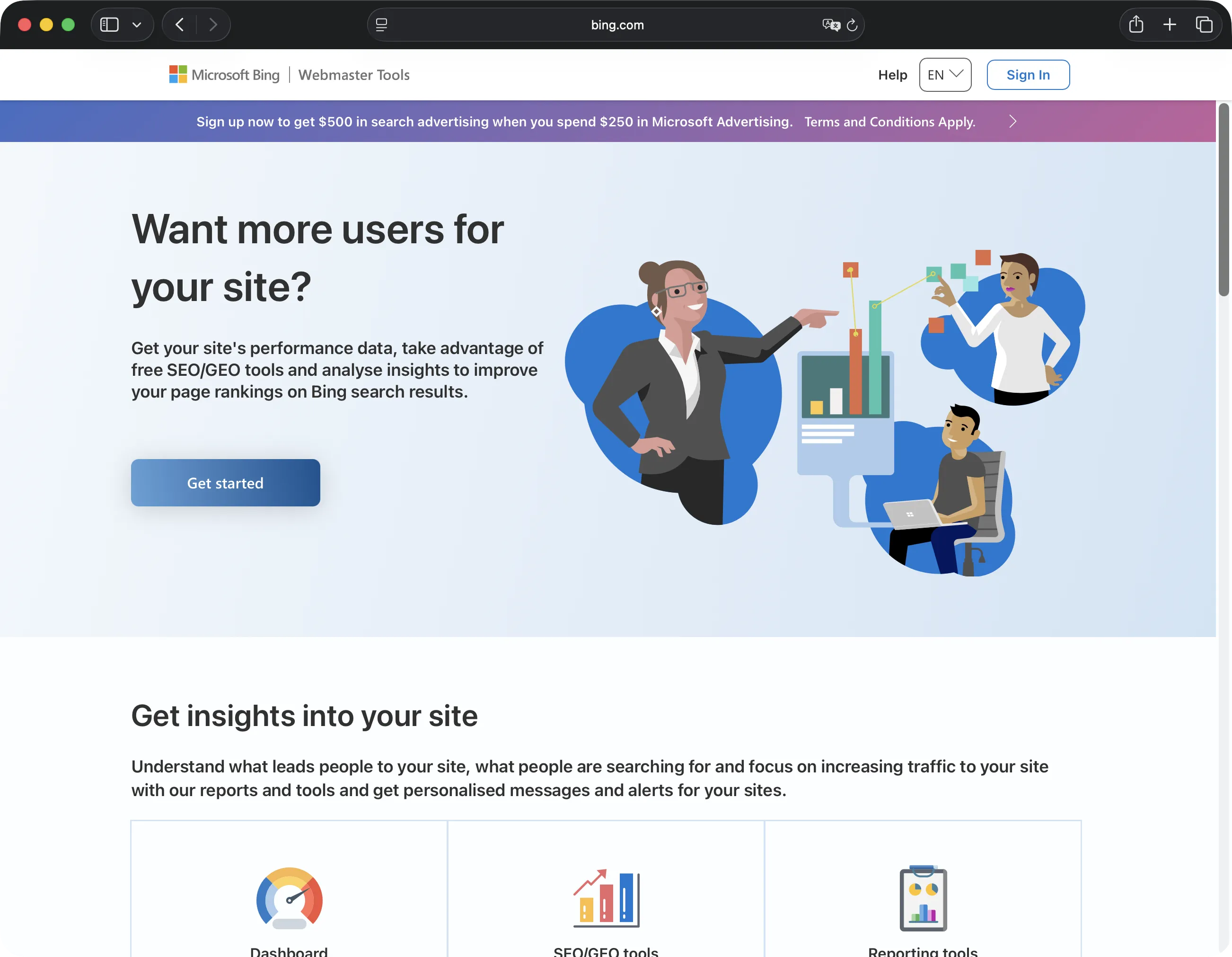
Go to webmaster.bing.com and sign in with a Microsoft account.
If your site is already verified in Google Search Console, you can import it directly by signing in with your Google account. This lets you skip the remaining verification steps.
Click Add a site and enter your domain.
Choose verification via XML file, meta tag, or CNAME record. The meta tag method is fastest if you have access to your site's
<head>.Paste the tag, publish the change, then click Verify in Bing Webmaster Tools.
Submit your sitemap
In your dashboard, go to Sitemaps in the left menu.
Enter your sitemap URL (usually
yourdomain.com/sitemap.xml).Click Submit. Bing will begin crawling within 24 to 72 hours.
Pro tip: Check the Crawl Errors report after 48 hours. Fix any 404s or blocked URLs. Bing surfaces these errors clearly and resolving them directly improves how much of your site gets indexed, and therefore how much gets fed into ChatGPT.
Step 2: Submit key pages to OpenAI directly
OpenAI runs a product discovery form at openai.com/chatgpt/search-product-discovery that lets you submit specific pages for indexing consideration. Note that this form is currently designed for e-commerce and product pages, not for service or content pages. Still, it is worth monitoring as OpenAI expands this channel.
Step 3: Structure every page to match how AI reads content
AI tools do not read websites the way humans do. They scan for clear structure, extract short answer blocks, and look for headings that match user queries. Here is what to implement on every important page.
Use question-based H2 and H3 headings
Replace vague headings like "Our approach" with specific questions: "How do we help B2B companies grow their brand?" or "What does a Brand Transformation project include?" These map directly to how people phrase prompts in ChatGPT.
Write one 40-word answer block per topic
After each question-based heading, write a single paragraph of roughly 40 words that answers the question completely and stands alone. This is the format AI models extract and cite. Think of it as writing for a snippet box. Everything after that paragraph can go deeper, but the first response must be self-contained.
Use bullet lists and tables for structured information
Lists and tables are machine-readable by design. If you have a comparison, a process, or a set of options, format it as a table or a numbered list rather than prose. This dramatically increases the chance of being cited verbatim.
For practical guidance on structuring your site content to perform in both traditional and AI search, see HIVER's SEO guide for your website, which covers content hierarchy, metadata, and on-page optimization in a format you can work through immediately.
Step 4: Add structured data (schema markup)
Schema markup is code you add to your pages that tells search engines and AI crawlers exactly what your content is. You do not need a developer to do this. Most CMS platforms have plugins or built-in fields for it.
The schema types that matter most for SMEs
Schema type | When to use it | AI benefit |
|---|---|---|
Organization | Homepage and About page | Tells AI your name, location, website, and social profiles |
LocalBusiness | Any business with a physical address or local service area | Powers local AI results and map integrations |
FAQPage | Pages with question-and-answer content | Directly feeds the Q&A format AI tools prefer |
Article / BlogPosting | Blog posts and guides | Signals authoritative content for topic-based queries |
Person | Team bios and founder pages | Helps AI identify and cite your experts by name |
For LocalBusiness schema, include a sameAs array with links to your Google Business Profile, LinkedIn, and any industry directories. Pair this with identical NAP data (name, address, phone) across at least 30 directories. AI tools cross-reference this data to confirm your business is real and relevant.
Generate your schema markup with Claude
You do not need to write schema code by hand. Paste the prompt below into Claude (claude.ai), replace the placeholder with your website URL, and it will generate ready-to-use JSON-LD markup for your most important pages.
Once Claude returns the code, paste each <script type="application/ld+json"> block into the <head> of the corresponding page. In most CMS platforms, there is a custom code or SEO settings field where you can do this without touching the template.
Step 5: Build your brand's presence outside your own site
AI tools do not only read your website. They read everything that mentions you. Third-party mentions, interviews, guest articles, and podcast appearances all contribute to how often an AI will reference your brand unprompted.
Get mentioned on credible external sites
Write guest articles for industry publications your clients actually read.
Appear on podcasts as a guest. Even a single appearance creates a transcript, show notes, and often a backlink, all of which are indexed.
Ask satisfied clients to mention you in their own blog posts or case studies.
Write keyword-rich bios for every team member
This is one of the most overlooked tactics. Instead of "Anna is our Head of Marketing," write: "Anna is a B2B marketing strategist who helps Swiss software companies build brand authority and generate inbound leads." When someone asks ChatGPT for a B2B marketing strategist in Switzerland, Anna's bio is now a candidate for citation. Apply this logic to every person on your team page and on LinkedIn.
Key insight: AI tools are much more likely to name-drop specific people than generic companies. Personal expert positioning is one of the fastest routes to organic AI visibility.
Step 6: Target long-tail question keywords
Vague keyword targets like "branding agency" or "web design Switzerland" are too competitive and too broad for AI to cite with precision. Long-tail question titles perform far better. Think: "How do Swiss B2B companies build brand trust with enterprise clients?" or "What should a 50-person company include in a brand strategy?"
These phrases match exactly how people type prompts into ChatGPT. Create one dedicated page or article for each question your ideal clients are genuinely asking. You do not need hundreds of pages. Ten well-structured pages that each answer one question clearly will outperform a hundred thin pages.
If you want to see what this looks like in practice, the guide on what actually makes websites convert is a good example of a page structured to answer one specific question in depth.
Step 7: Keep your content current
AI tools weight recency. A page last updated in 2022 carries less authority than one refreshed in 2025 or 2026. You do not need to rewrite entire articles. Update the date, refresh any outdated examples, add a new section if the topic has evolved, and re-submit the URL to Bing Webmaster Tools.
Set a quarterly calendar reminder to review your top ten pages and make at least minor updates. This alone can recover visibility that has slipped due to stale content.
How to test if AI can actually find you
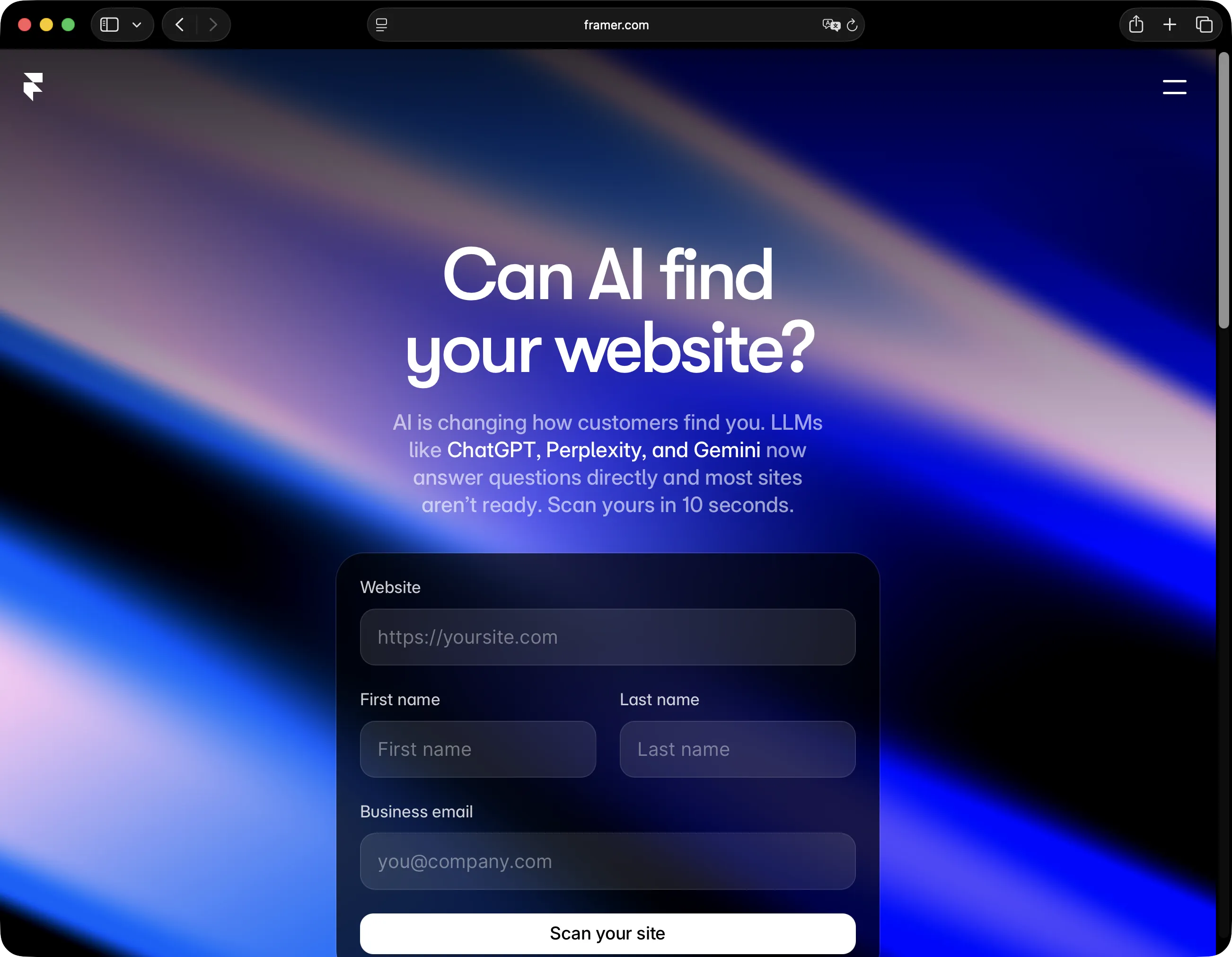
Before optimizing further, it is worth knowing where you currently stand. Framer's AEO checker is a free tool that analyzes your website and scores how well it is optimized for AI search engines. It checks factors like structured data, content clarity, and crawlability, then gives you a concrete list of what to fix. Run it on your homepage and your most important service pages to get a baseline before and after implementing the steps in this guide.
The AEO and GEO mindset shift
AEO (Answer Engine Optimization) and GEO (Generative Engine Optimization) are the terms used to describe SEO adapted for AI tools. The core shift is this: traditional SEO gets you ranked, AEO and GEO get you cited. The goal is not just to appear in a list of links but to be the source an AI quotes when summarizing an answer.
For SMEs, this is genuinely good news. Large enterprises often have slow content processes and outdated sites. A 50-person company with a well-structured website, clear expert bios, and a handful of focused, question-answering articles can outperform much bigger competitors in AI search.
If your brand, website, and content positioning are not yet ready for this level of visibility, the Brand Transformation process at HIVER is built specifically to get SMEs to that foundation: clear positioning, structured web presence, and content that both humans and AI tools can understand and cite.
Troubleshooting: common problems and fixes
Problem | Likely cause | Fix |
|---|---|---|
Site not appearing in Bing at all | Sitemap not submitted or crawl errors blocking key pages | Submit sitemap via Bing Webmaster Tools, fix all crawl errors |
ChatGPT cites competitors, not you | Their content is more structured or better linked externally | Add 40-word answer blocks, get more third-party mentions |
Local queries return no mention of your business | Missing LocalBusiness schema or inconsistent NAP data | Add schema markup, audit and unify all directory listings |
AI describes your service inaccurately | Homepage copy is vague or uses internal jargon | Rewrite the first 100 words of your homepage to be direct and specific |
Good content but no external citations | No backlinks or third-party mentions | Prioritize one guest article or podcast appearance per quarter |
Author

Alexander Winter
Founder & Writer
Alexander is the founder of HIVER, writing about design, branding and building products that people love to use. He is deeply rooted in SaaS, tech marketing and branding, and brings strong expertise in video production and storytelling.